| |
| Wednesday, 14 October 2026 |
| The Culture of Ukraine |
| Rosamund Bartlett (Arts Society) |
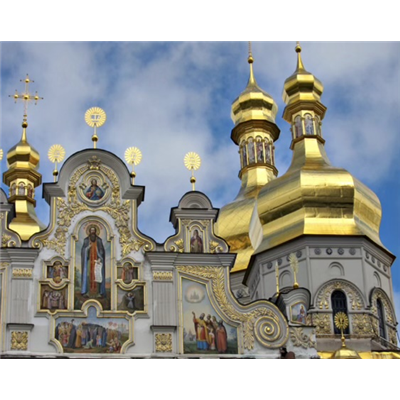 |
This lecture tells the multifaceted Ukrainian story through the shared culture which binds its diverse people together, including the sacred art and architecture of Kyiv inherited from Byzantium, the rich legacy of the Cossacks, and a treasury of poetry, painting and song. We will also look at the key role played by folk culture in the years before Ukraine's emergence as an independent nation, and "red icons" on glass and the country's remarkable embroidery tradition, which had a surprising influence on avant-garde art. Biography
Rosamund is a writer, lecturer and translator whose work ranges across the arts, and across the cultures of Europe, from Italy to Norway. She began her career as an academic in Slavic studies after completing her doctorate at Oxford, and has held fellowships both in the UK and at the European University Institute in Florence. In 2024 she became a Royal Literary Fund Fellow at Brasenose College, Oxford.
The author of several books, including biographies of Chekhov and Tolstoy, and a study of Wagner's influence in Russia, she is also well known as a translator - her publications include acclaimed editions of Anna Karenina and Chekhov's stories for Oxford World’s Classics. She has written on music and literature for institutions including the Royal Opera House, the National Theatre and the Salzburg Festival, and about art for Apollo and The Burlington Magazine. She is currently writing a book about the revolution in the arts which took place in early 20th-century Moscow, St. Petersburg, Kyiv and Odesa, and its connection to modernist developments in Paris, Munich and Milan.
She has led art, architecture, design and music tours throughout Europe, and contributes regularly to Proms events and opera broadcasts on the BBC. Her lecturing work has taken her from the Ashmolean Museum in Oxford where she lives, to the V&A in London, and to the Art Gallery of New South Wales in Sydney. Our lectures take place at Merchant Taylors Hall, York, YO1 7BX. The lecture starts at 6.30pm with reception from 6pm. |
|
| Wednesday, 11 November 2026 |
| From Cradle to Cave: The Iconography of the Nativity in Late Medieval Italian Art |
| Helen Dejean (Arts Society) |
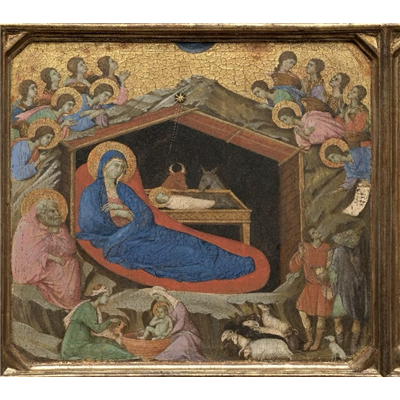 |
The classic and very popular Christmas lecture! What does the ancient Nativity icon from the Orthodox East actually mean and why does late Trecento art show something different? We track the fascinating development of the Nativity image over 1,700 years, from its Byzantine roots to the more familiar but very different devotional images from late 14th century Italy. What happened to change things? Biography
Helen is an established art history lecturer and tutor specialising in Byzantine and Late Medieval Italian art. She is currently reading for a PhD in Byzantine history of art at The Courtauld Institute, London where she is also teaches on the Short Courses and BA programmes. Helen also holds a Masters degree in each of her subject areas from the Courtauld, a BA Hons from the Open University, a diploma in Fine Art and a teaching qualification.
Helen is also an art history tutor for City Lit, London, and has previously worked in the London Art Auction world (MacDougall's and Christie's), as well as in the museum and further education sector. For many years, Helen combined her specialist knowledge of art history with her specialist art practice of icon and medieval panel painting to deliver art commissions and art history and painting courses in the UK, Italy and Sinai. Helen is the founder and owner of ‘Elenis Icons’ - through which she continues to undertake commissions for churches, cathedrals and clients worldwide. Our lectures take place at Merchant Taylors Hall, York, YO1 7BX. The lecture starts at 6.30pm with reception from 6pm. |
|
| Wednesday, 13 January 2027 |
| Journey Across the Himalayas |
| Zara Fleming (Arts Society) |
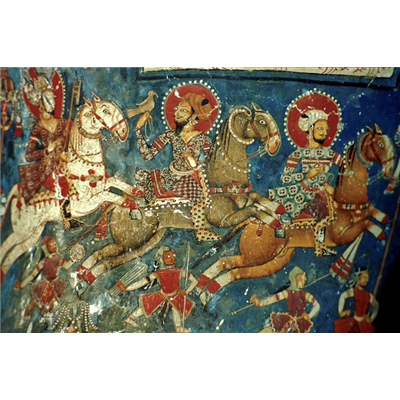 |
This lecture will focus on the Buddhist areas of the highest mountain range in the world, the Himalayas. The once spiritual domain of Tibetan culture and religion, spanning 2000 miles from Ladakh in the west to Bhutan in the east. It will explore the kingdoms and principalities of Ladakh, Zanskar, Spiti, Lahoul, Nepal, Mustang, Sikkim, Bhutan and their spiritual heartland of Tibet. Many of these countries lay on the ancient trade routes connecting India with Central Asia, and although isolated became important centres of Buddhist art and culture, housing vast repositories of sacred art in their remote monasteries and temples. Biography
Zara is a freelance lecturer, art consultant and exhibition curator specialising in the art and culture of Tibet, the Himalayan areas and Mongolia. Initially based at the V&A, she has also worked with the Central Asian Department of Bonn University, the Orient Foundation, the Royal Academy, Tibet House, the National Museums and Galleries on Merseyside and Asia House. In addition to lecturing for The Arts Society, she lectures for museums, universities, Asian art societies, and private associations. She is a guest lecturer and tour guide on numerous trips to the Himalayas. She edited Masterpieces of Mongolian Art: Vol 1 and has published many articles in the field of Buddhist art and culture. Our lectures take place at Merchant Taylors Hall, York, YO1 7BX. The lecture starts at 6.30pm with reception from 6pm. |
|
| Wednesday, 10 February 2027 |
| Art Nouveau Architecture Around the World |
| Ian Gledhill (Arts Society) |
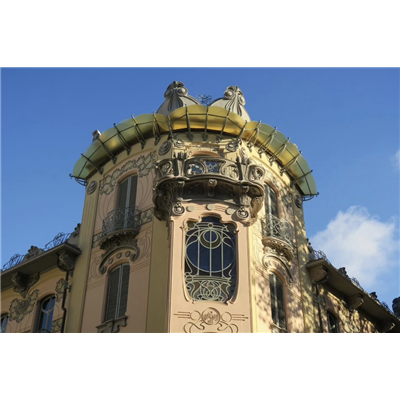 |
Ian will be looking at the influence the style had in different countries, including Britain, Austria, Spain, Latvia and America. Despite the fact that Art Nouveau was originally largely inspired by British designers, the style found little favour in this country. While French and Belgian architects used plant forms to create organic three dimensional forms, Austrian Art Nouveau is surprisingly flat, and in Barcelona Antoni Gaudi’s buildings seem much more based on animal shapes than plants. Biography
Ian Gledhill has had a very varied career, from designing underground railways as an engineer for London Transport, to appearing in pantomime with Julian Clary. In between he has worked in travel and tourism, music publishing, television, and especially the theatre, where he has been an actor, director, set designer, stage manager and opera translator. His main interests include architecture, history, transport and classical music, especially opera and operetta, and these are reflected in the wide ranging list of subjects for his lectures. |
|
| Wednesday, 10 March 2027 |
| Echoing the Scream and the Birth of Modernism |
| Gavin Plumley (Arts Society) |
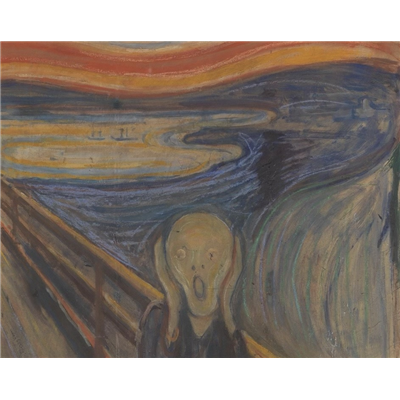 |
When Edvard Munch created The Scream in 1893, he was responding to an intense emotional experience. Today, we would call it a panic attack. Crippling and anxious making, this primal cry was also a rallying call: for Munch and for the wider world of art. It gave birth to a movement known as expressionism, showing life not at it is (realism) or as it might be perceived in a fleeting moment (impressionism), but as it is experienced within the unembellished core of our being. Explosive and emotive, the aftershocks of Munch’s vision were felt across the world: in art and music, literature, dance and film. Biography
Gavin Plumley is a writer and broadcaster, appearing on BBC Radio 3, BBC Radio 4 and contributing to newspapers, magazines and opera and concert programmes worldwide. He lectures widely about the culture of Central Europe during the 19th and 20th centuries. Recent talks include the Royal Opera House, the National Gallery, the National Trust, the National Theatre, the British Museum, the V&A, the Southbank Centre, the Tate and the Neue Galerie, New York, as well as for history of art societies and The Art Fund. His first book, A Home for All Seasons, was published by Atlantic Books on 2 June 2022. Our lectures take place at Merchant Taylors Hall, York, YO1 7BX. The lecture starts at 6.30pm with reception from 6pm. |
|